A research project of the Institute of Nursing Science - University of Basel

INTERSCALE Study

Successfully Implementing INTERCARE—With a Clear Strategy

The implementation of INTERCARE is an organizational development process that requires careful planning. The following measures (implementation strategies) have proven effective in the INTERCARE institutions:

  • Introductory workshops with the participating LTCFs
  • Regular coaching for LTCF management and INTERCARE nurses
  • A training program (CAS INTERCARE)
  • Feedback on quality indicators (e.g., hospital transfers)
  • Supporting materials for implementing the core components

These implementation strategies were crucial to success—but they were also resource-intensive. For INTERCARE to be widely adopted, the benefits must be in good proportion to the costs and effort involved.

INTERSCALE Project Timeline

*These findings enable policymakers, provider associations, and other organizations to provide optimal support to long-term care facilities in strengthening their nursing expertise and further improving the quality of care, so that they can meet current and future challenges.

INTERSCALE Process

Study Timeline

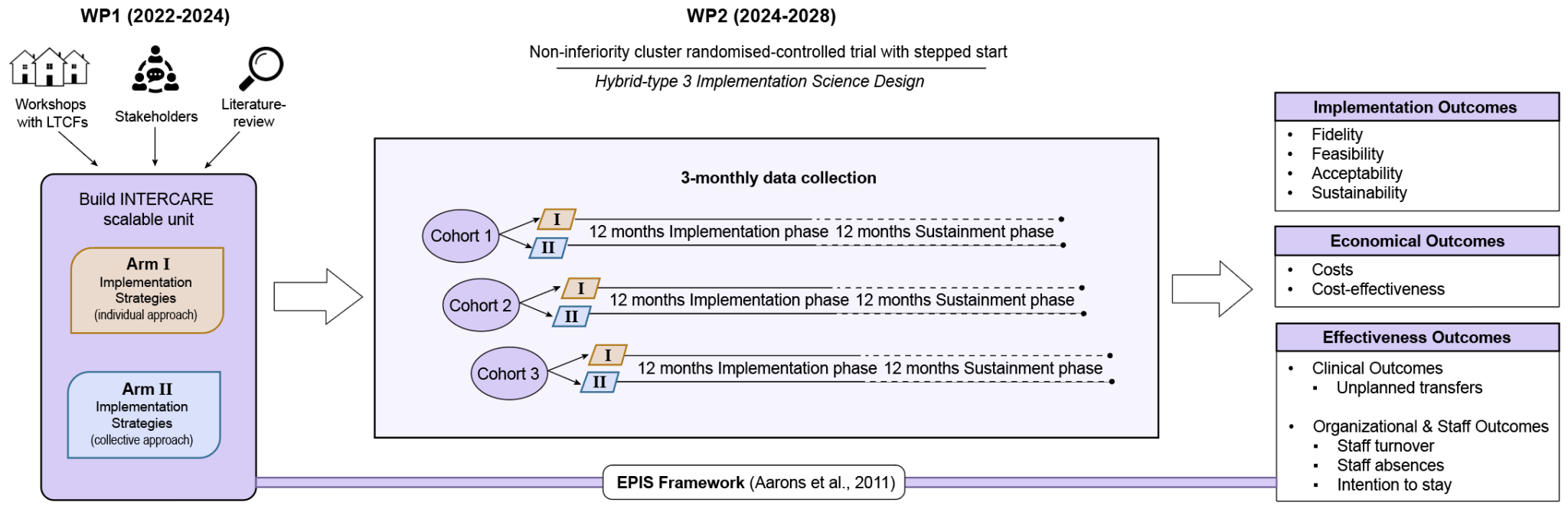
In Work Package 1 (WP1), the INTERCARE model was revised and updated based on experiences from the initial implementation (e.g., adapting the training content for INTERCARE nurses to current evidence, updating informational/supporting materials for LTCFs).

At the same time, appropriate implementation strategies were developed for Work Package 2 (WP2) that are less resource-intensive than those used in the first implementation of INTERCARE. For example, strategies’ duration, frequency, or format can be modified, or certain strategies can be omitted or replaced with less resource-intensive alternatives. The development is based on a theory-driven contextual analysis that updates the barriers and facilitators to implementation identified in the first round.

The update and development were carried out using a participatory approach involving a working group of LTCFs and a stakeholder group.

  • LTCFs: institutions from the first round (INTERCARE) and institutions interested in the INTERSCALE study
  • Stakeholder groups: all stakeholders from the first round, with additional groups (e.g., representatives from politics, government agencies, service providers, professional associations, and resident councils).

The goal of the workshops with the working group was to identify the need for adjustments. Further, it aimed to provide context-specific updates of both the INTERCARE model and the implementation strategies, or to develop new implementation strategies.

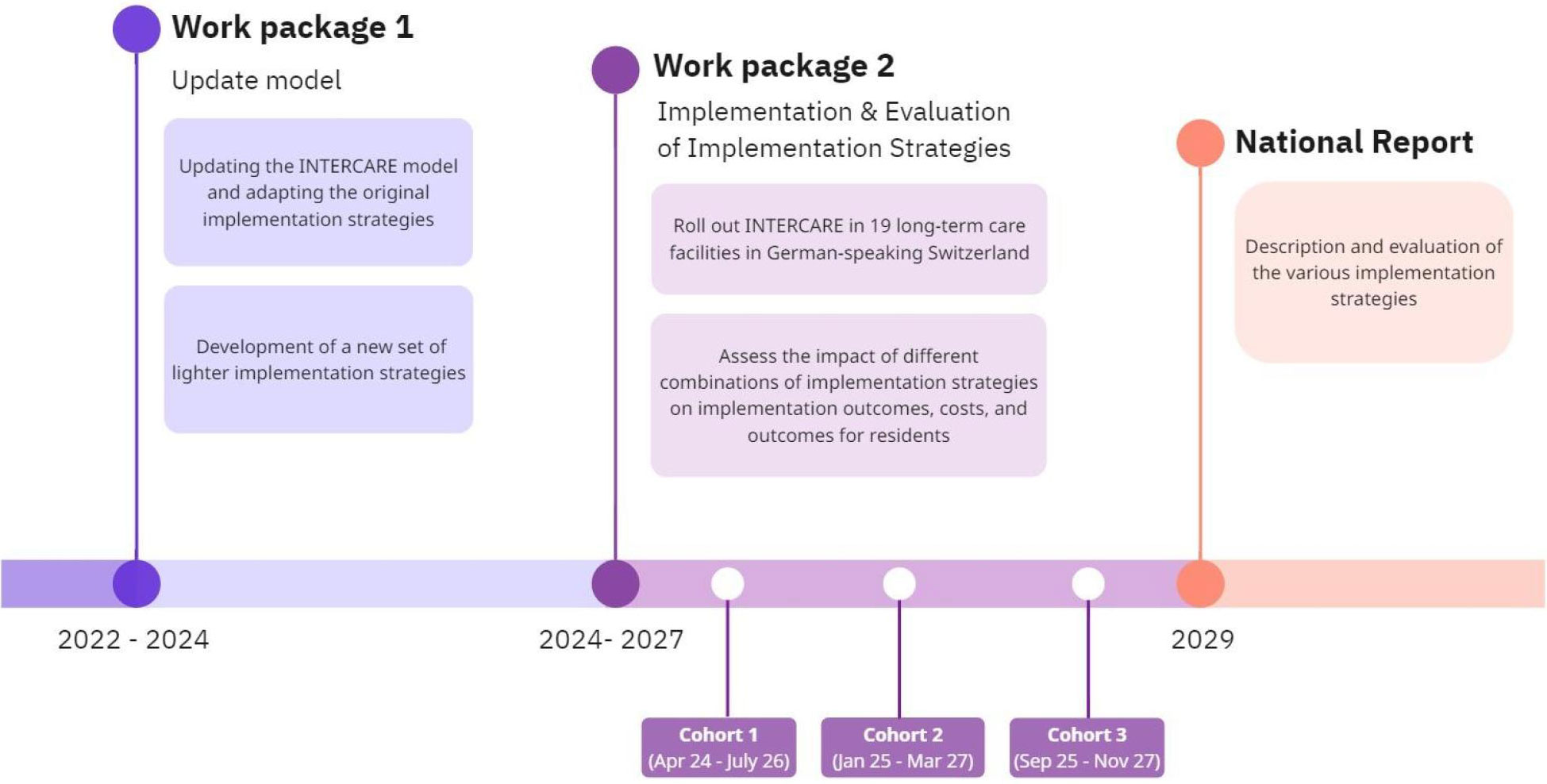
In WP 2, INTERCARE will be introduced in a cluster-randomized controlled trial at 19 LTCFs in German-speaking Switzerland. The participating LTCFs will be randomly assigned to two study arms. Both arms will introduce the INTERCARE intervention.

  • In the first arm, the implementation strategies will be applied in the same way as in the INTERCARE study.
  • In the second arm, an adjusted, less cost-intensive version of the implementation strategies will be implemented.

The study started in 2024, and the intervention lasts 25 months per LTCF (staggered start with 3 cohorts).

The evaluation will examine various outcomes:

  • Implementation outcomes: The effectiveness of the different implementation strategies will be examined in terms of, e.g., fidelity to the core components of INTERCARE. Further, the acceptability and feasibility of the implementation strategies will be assessed, and the sustainment of implementation will be evaluated up to 2 years after the start of implementation
  • Clinical outcomes, i.e., reduction in the number of unplanned hospital transfers
  • Costs and cost-effectiveness: The study will examine the costs of implementation from the perspective of the research group and the LTCFs and determine which combination of implementation strategies is more cost-effective.
  • Organizational outcomes: We are examining how absences and staff turnover evolve over the course of study participation.

Funding

INTERSCALE is financially supported by:

This site is registered on wpml.org as a development site. Switch to a production site key to remove this banner.